Friday, January 4, 2008 - Port Gibson MS
< previous day | archives | next day >
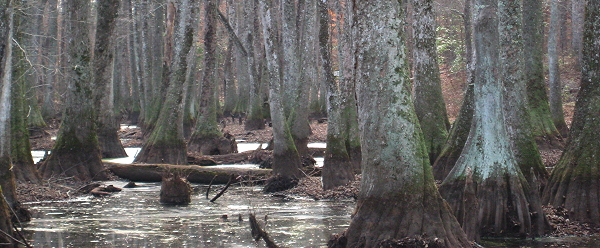
Don't feed the aligators, Natchez Trace Parkway, Southern Mississippi, January 4, 2008
Yes, alligators, up here near Jackson, Mississippi
Occasionally at least; there is a sign at this roadside nature attraction on the Natchez Trace Parkway cautioning one not to feed the normally shy alligators lest they become less shy.
McGivney Tire and the catalytic converter
The mechanic at McGivney Tire Service took good care of me and after overcoming a bit of trouble getting the old exhaust system to mate up with the new catalytic converter saw me on my way in the early afternoon. I made the right decision in getting the catalytic converter replaced. The change in engine performance is dramatic. She can breathe again. I had no idea LD was laboring so seriously trying to blow hot exhaust through a plugged pipe. No wonder the exhaust manifolds turned blue. The engine feels free and easy breathing and runs and accelerates much smoother. And the exhaust manifold leak I've dreaded finding someone willing to fix seems to be non existent. Even the hesitation and stumbling that started this whole round of repairs is largely gone. I'd wager gas mileage is better too. I never would have guessed a partially blocked catalytic converter would have effected performance in so many ways.
Grand Gulf Military Park
Late afternoon, on the Natchez Trace Parkway, headed for toward Natchez, Mississippi, I saw a sign for Grand Gulf Military Park and campground. On a whim I decided to check it out even though it was 12 miles out of my way. Just maybe it would be on the Mississippi river and I'd like that. It's way down a dead end road that indeed stops just shy of the river. I think. It's dark; about 6 pm. When I go by the gates are closed. Darn. I went on by to the end of the road to turn around and when I got back up to the park the crew had the gate open and people in the road waving me down. What's happening? Did the Nuclear power plant up the road let one rip? Naw. They saw LD and me go slowly by and wanted to invite me in. They got me settled and asked me to drop by the museum tomorrow morning to check in. No Wal-Mart for LD and me tonight.
Night camp
Grand Gulf Military Park, Port Gibson, Mississippi
