Tuesday, February 8, 2011 - Bosque Birdwatchers RV Park, San Antonio NM
< previous day | archives | next day >
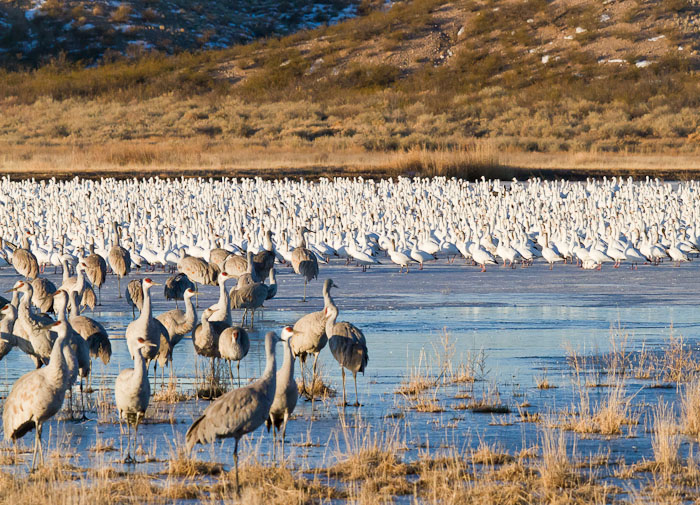
Ready, Set, .., Snow Geese, Bosque del Apache National Wildlife Refuge, San Antonio NM, February 8, 2011
Explosion
People travel miles to see what comes next. Now I know why. A few thousand Snow Geese resting on the ice out beyond the cranes suddenly stood up en masse, turned, and blasted off in a furious, roaring, quacking, cloud of flapping wings.
This neophyte didn't know this was coming and wasn't ready to get a worthy picture but maybe I can tease something from the few caught by my urgently flapping of the shutter that'll give some hint of this startling, awesome eruption to put up here tomorrow.
Night camp
Site 10 - Bosque Bird Watcher's RV Park, San Antonio NM
- This is a basic, small Mom & Pop RV Park with full hookups.
- Verizon cell phone and Broadband service are available here with a strong signal.
- Locate Bosque Bird Watcher's RV Park on my Night Camps map
- Click for Google street view
- Check the weather in San Antonio NM
Words Get in the Way

Research shows that language suppresses visual memory, This is called verbal overshadowing and is a well-established phenomenon .... For example, in one study people watched a short videotape of a bank robbery, then spent twenty minutes doing something unrelated. Then one group spent five minutes writing down everything they could remember about the bank robber's face, while the other group did an unrelated task.