Primitive Campground at Fort Stanton Cave, Lincoln NM
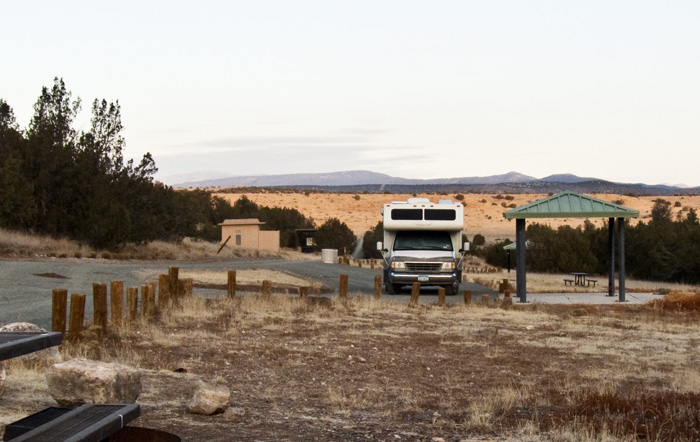
Dawn at Fort Stanton Cave, December 19, 2009
This little, 3 site, primitive campground is at the entrance to the Fort Stanton Cave in the new Fort Stanton-Snowy River Cave National Conservation Area off US 380 west of Lincoln NM. This Conservation Area was established in 2009 to protect and conserve the unique and nationally important subterranean cave resources of the Fort Stanton - Snowy River cave system. Snowy River is a significant passage within Fort Stanton Cave. This campground primarily serves those who have been issued a permit to enter the cave.
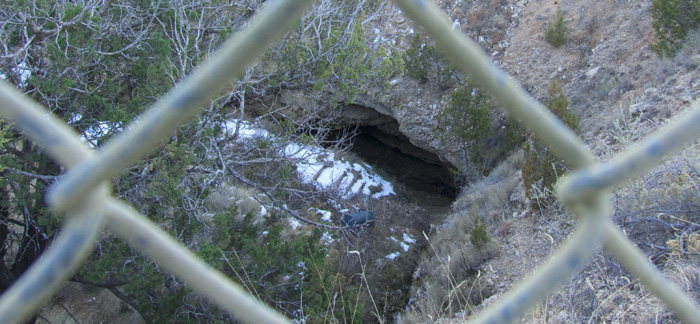
Fort Stanton Cave entrance, December 18, 2009
With 14-3/4 miles of mapped passages, Fort Stanton Cave is the third largest cave in New Mexico. The cave is open for recreational caving under permit from April 15 to November 1.
Snowy River Passage in Fort Stanton Cave
To quote the Bureau of Land Management
Very slow moving ground water dissolved the grayish-brown limestone in which the cave is formed and recrystallized that limestone into a white-colored mineral called calcite. Through numerous infillings of ground water saturated with calcite, followed by draining and drying, repeated coats of calcite were laid on the bottom of the cave through the entire five miles of Snowy River passage that has been surveyed to date. This unique white crystalline deposit glistens like snow and may be the largest calcite formation in America. Several endemic microorganisms have been discovered in this new section of the cave. In this sunless environment, species living here do not get their energy from the sun. Instead, they chemically break down rock. In the process, they create chemical byproducts that could have pharmaceutical uses. There are also several species that have formed symbiotic relationships with each other.
Continuing exploration and scientific research will help us better understand the formation of caves in this area, improve our understanding of groundwater hydrology of the region, and increase our knowledge of the biology of the cave. In the years to come, many new biological discoveries are anticipated.
Due to the scientific importance of the cave, the Snowy River passage is not open to the public. BLM is planning interpretive products in the future so the public can enjoy and better understand this unique resource.
Read Snowy River Passage for more info.
Primitive Campground at Fort Stanton Cave, Lincoln NM
- This is a primitive campground with three sites and a single pit toilet.
- Verizon cell phone and Broadband service is good.
- Fort Stanton-Snowy River Cave National Conservation Area info
- Locate Fort Stanton Cave Campground on my Night Camps map
- Check the weather here
Nights I've camped here
Mix With the World
I am convinced our own happiness requires that we should continue to mix with the world, and to keep pace with it. . . . I can speak from experience on the subject. From 1793 to 1797, I remained closely at home, saw none but those who came there, and at length became very sensible of the ill effect it had upon my mind, and of its direct and irresistible tendency to render me unfit for society, and uneasy when necessarily engaged in it. I felt enough of the effect of withdrawing from the world then to see that it led to an anti-social and misanthropic state of mind, which severely punishes him who gives in to it; and it will be a lesson I never shall forget as to myself.
John Adams